Last updated 2026-08-19
TL;DR
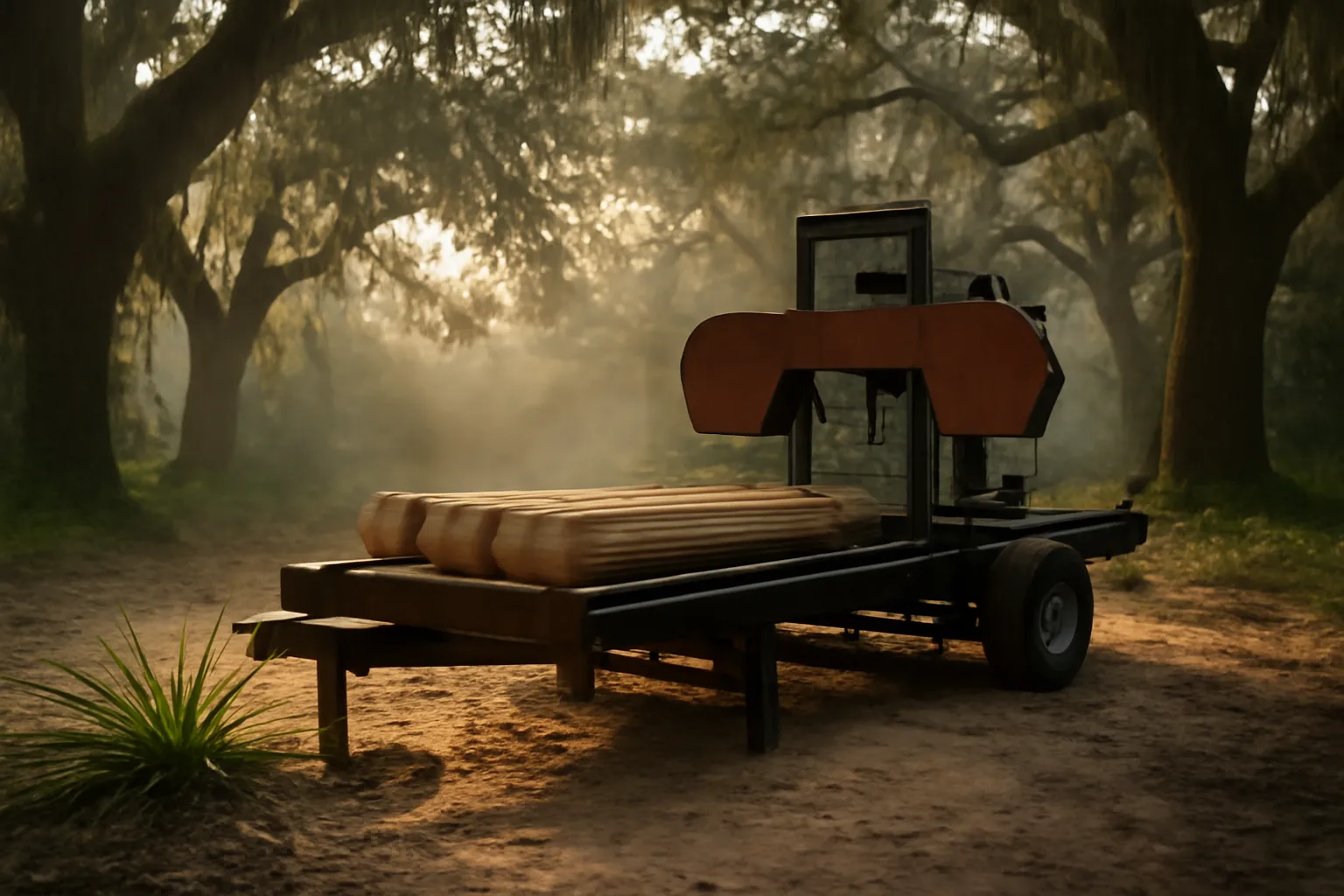
A portable sawmill in Florida costs $4,000 to $90,000 for the machine, then sales tax, blades, and haul gear. Florida has no statewide mill operator license. You still need a local business tax receipt where levied, and a DOR sales tax account if you sell lumber. Sunbiz filings can be fast. Confirm fees with the county tax collector and Florida DOR. Nobody honest promises a start date.
How much does a portable sawmill cost in Florida?
A portable sawmill in Florida costs about $4,000 to $9,000 for a small manual mill, $15,000 to $45,000 for a mid-size hydraulic mill, and $45,000 or more for a production portable. Add Florida's 6 percent state sales tax and any county discretionary surtax unless the Department of Revenue confirms an exemption. Used prices run lower and swing hard with rust, hours, and missing parts.
There is no official Florida sawmill price list. The machine is a national product. What changes here is tax, freight to a Florida dealer or your gate, corrosion, and the extra gear that humidity and storms push you to buy.
I treat the mill as half the check. A trailer that matches the mill, a truck that pulls it on sand and clay, cant hooks, a decent chainsaw, fuel cans, spare blades, and a dry place to park the thing all add up. People who price only the saw head get surprised in month three.
New hobby mills (narrow bed, hand crank, small log diameter) are fine for slabs you keep. They are a slow way to get paid. If you want custom work for landowners, skip the cheapest new mill and look at a used hydraulic in the middle band. Budget a mechanic visit before you tow it home.
Production portables with wide beds, setworks, and power clamps cost real money. They pay if you have logs lined up. They are a waste if you have six oaks in the yard and a hopeful Facebook post.
Florida sales tax applies to most retail purchases of tangible personal property. The Florida Department of Revenue states the state rate as 6 percent, and many counties add a discretionary surtax. [6] Ask the seller whether the quote is out the door. An out-of-state dealer still creates a use-tax question. Confirm that with DOR, not a forum thread.
A manufacturing machinery exemption exists in Florida statute for certain industrial equipment. [3] Custom sawing as a service is not the same fact pattern as a plant that manufactures lumber for inventory. Do not bank on that exemption until a Florida CPA or written DOR guidance says it fits your facts.
Freight into the Panhandle is not the same as freight into Miami-Dade. Keys and island jobs have bridge and boat problems of their own. Price delivery before you fall in love with a mill sitting in another region.
Want a nearby-state cost picture after this one? Read portable sawmill cost in Georgia. The machine bands look similar. The paper does not.
Do you need a license for a portable sawmill in Florida?
No. Florida does not issue a statewide portable sawmill operator license. You may still need a local business tax receipt, a Sunbiz entity or fictitious name, and a Florida sales tax account if you sell lumber or other taxable goods. Worker and safety rules apply even when no mill license exists.
I went looking for a Florida statute that licenses portable mill operators the way some trades are licensed. I have not found one. That is not a free pass. Counties and cities may levy a local business tax for the privilege of engaging in business. [1]
Florida Statute 205.032 is the county authority. Your receipt comes from the county tax collector or the city, not from a sawmill board. Rates and business categories differ by place. Confirm the category and the current fee with that collector. I will not invent a Tampa, Orlando, or Jacksonville dollar amount.
Sell boards, and you are generally in the sales tax system. Florida Statute 212.05 opens with this line: "It is hereby declared to be the legislative intent that every person is exercising a taxable privilege who engages in the business of selling tangible personal property at retail in this state." [2] Register on the current Florida business tax application. [13] Custom milling where the customer owns the log and takes back their own wood can be a different tax fact than buying logs and selling lumber. Get that distinction from DOR or a Florida tax pro. Do not guess on a job ticket.
Sunbiz is the Division of Corporations. Florida LLC articles of organization cost $125 to file. [4] That filing is not a mill license. It is an entity filing. A fictitious name is separate paper if you hang out a name that is not your legal person or entity name.
Hire anyone, and workers' compensation and federal employment rules show up fast. Florida Statute 440.10 requires covered employers to secure compensation for employees. [7] Officer exemptions are formal filings, not vibes. Confirm with the Division of Workers' Compensation. Do not assume a handshake helper is only a friend.
OSHA applies on a landing in Levy County the same as it does in a shed. 29 CFR 1910.265 is the federal sawmill standard. [8] Woods work beside the mill can pull in the logging standard too. [14] No Florida card replaces that.
How long does a portable sawmill take in Florida?
Buying a mill takes a day on the used market or several weeks if you order new. The state entity filing can be quick online. Local business tax receipts and sales tax accounts are their own queues. I will not quote a processing day count. Confirm current turnaround with Sunbiz, DOR, and your county tax collector.
How long a portable sawmill takes in Florida is really three clocks. The machine clock. The paper clock. The skill clock.
The machine clock is inventory. A dealer with a floor model can load you this week. A factory slot is a manufacturer question, not a Florida agency question. Storm season slows trucks and can strand a mill you already own if you skipped a tie-down or a shed.
The paper clock is local. Sunbiz online filings are often the fastest piece. County receipts may need a physical address, a zoning look, or an in-person stop. DOR registration is a separate account. [13] Nobody honest guarantees you will be clear to sell on Saturday.
The skill clock is yours. You can cut a rough 4x4 the first afternoon. Clean, repeatable hardwood for a paying customer takes practice. Sandy Florida logs dull blades. Wet live oak and sweetgum move after you cut them. Budget time to ruin some cants that belong to you, not to a customer.
Land work can dwarf the filing time. Rock on a sand drive, a gravel pad, a shed that takes wind. A mill sitting in a puddle is not in business.
Cut across the state line, and do not assume one receipt covers both sides. Compare the mix with portable sawmill cost in Alabama.
What does a realistic first-year Florida mill budget include?
A tight first year in Florida often lands between about $8,000 and $25,000 if you buy a used mid mill and already own a truck. A cleaner new-mill path with a trailer, blades, and a dry parking spot often runs $25,000 to $60,000 before a loader or a kiln. Production setups with handling gear run higher. Those are planning bands, not a state fee schedule.
The mill check is the line people remember. The quiet lines are Florida tax on a taxable purchase, blades in sandy logs, dyed diesel or gasoline, a spot the mill will not sit in standing water, and liability insurance you actually get quoted. I will not invent an insurance premium. Ask a Florida agent who has written inland marine on equipment that lives outside.
| Line item | Honest planning band | Confirm with |
|---|---|---|
| New portable mill | $4,000 to $90,000 | Manufacturer or dealer quote |
| Used portable mill | $2,500 to $40,000 | Inspection, not a phone photo |
| Tax on a taxable mill | 6% state plus local surtax | Florida DOR [6] |
| LLC articles | $125 | Sunbiz [4] |
| LLC annual report | $138.75 | Sunbiz [5] |
| Blades, fuel, oil (year one) | $800 to $4,000 | Your hours and grit in the bark |
| Trailer and landing gear | $1,500 to $12,000 | If the mill is not already trailered |
I would rather own fewer attachments and more blades. Florida sand on the first log of the day will teach you why.
Skip the fancy computerized package in year one unless you already have contracted volume. A bent used bed for "cheap" is a waste. So is a mill you cannot shelter from a named storm.
Compare this sheet later with portable sawmill cost in Arkansas. Keep tax and rust in the Florida column. The saw head may be the same model.
What paper do you file with the state and your county?
Most Florida portable mill owners file some mix of a Sunbiz entity or fictitious name, a local business tax receipt where the county or city levies one, and a DOR sales tax account if they sell taxable goods. That stack is ordinary business paper. It is not a forestry license.
Start with how you will get paid. If checks come to your personal name and you never sell a board, your paper is lighter. The minute you invoice a homeowner for lumber, or hang a business name on a trailer, the stack grows.
Sunbiz first if you want an LLC. Florida LLC articles of organization cost $125 to file with the Division of Corporations. [4] The published LLC annual report amount on the Sunbiz annual report page is $138.75. [5] Confirm both on the live fee page before you pay. Do not treat those filings as permission to mill in a neighborhood that zoning does not allow.
Then call the county tax collector (and the city if you sit inside one) and ask whether a local business tax applies to sawing, manufacturing, or mobile services. Chapter 205 lets local governments levy that tax. [1] It does not force every county to charge the same category or the same dollar amount.
Then register with DOR if you will make taxable sales. Use the current DR-1 business tax application, not a blog checklist from 2018. [13] Reemployment tax is a separate DOR question if you have employees. Confirm the current new-employer rate on the DOR site. I will not lock a rate in this article.
Keep a written log ticket or contract on every job. Florida does not run a timber-dealer card the way some states do. You still need to show you had a right to cut or a right to be on that landing if a deputy asks.
Zoning is local. A home occupation rule in one county is an industrial-use fight in the next. Ask planning before you pour a pad. A tax receipt will not save you from a stop-work notice.
Do you pay sales tax on the mill and on lumber you sell?
Often yes on both, with exceptions you confirm rather than assume. Florida state sales tax is 6 percent, as stated by the Florida Department of Revenue. [6] Counties may add a discretionary surtax. The mill, blades, and many supplies are ordinary tangible property unless a documented exemption applies.
Selling boards at retail is the classic taxable privilege in Statute 212.05. [2] Charging to saw a customer's own log can be a service fact instead of a retail lumber sale. Mixed jobs (you buy some logs, they bring some) get messy. Put the facts in writing and ask DOR or a Florida CPA how to ticket them.
Statute 212.08 holds a long list of exemptions, including certain industrial machinery used in manufacturing. [3] Portable custom work is a weak place to freelance that statute. If the exemption matters to your quote, get it in writing.
Collecting tax you never registered to collect is a worse problem than registering and filing zeros in a quiet quarter. Filing frequency is a DOR assignment. Confirm it on your account. Do not copy a neighbor's schedule.
Out-of-state weekend work does not erase Florida tax on Florida sales. Pricing jobs in other states? Read portable sawmill cost in Illinois for a different tax climate, then keep the books separate.
What Florida land, water, and burning rules actually apply?
A portable mill on a one-day landing is mostly a forestry and access problem. A permanent yard with bark piles, slab decks, and a ditch to the woods is an environmental problem. Florida Forest Service silviculture BMPs are the water-quality baseline for forestry work. [9] They are not optional courtesy.
Harvest or skid, and stay out of streams the way the BMP manual describes. Wet-season clay in north Florida and sugar sand in the interior both punish heavy trucks. A wrecked county road approach costs more than a week of milling.
Burning slabs or sawdust is not a free backyard fire. Florida Statute 590.125 sets authorization rules for open burning tied to forestry and related work. [10] Call the Florida Forest Service process that applies to your county that day. A burn ban does not care that your slab pile is in the way.
A permanent concentration yard can trip industrial stormwater coverage. Florida DEP's Multi-Sector Generic Permit is the industrial stormwater paper for many timber-product sites. [12] A mill that truly lives on a trailer and leaves no industrial discharge is a different fact than a fenced yard with a ditch. Ask DEP which fact you are. Do not decide from a Facebook group.
Agricultural classification on the land (greenbelt) is Statute 193.461. [11] A bona fide timber or ag use can hold that classification. A commercial mill that looks like a factory to the property appraiser can put it at risk. Confirm with the county appraiser before you pour concrete.
HOAs and deed limits are private paper. They can block a mill even when the county would allow it. Read them.
What insurance and worker rules hit a small Florida mill?
Employees change everything. Florida workers' compensation is the first statute to take seriously. Statute 440.10 makes covered employers liable to secure compensation. [7] Confirm exemptions, if any, with the Division of Workers' Compensation. Misclassifying a regular helper as a contractor is how small outfits get expensive mail.
OSHA 1910.265 states, in part, "This section includes safety requirements for sawmill operations including, but not limited to, log and lumber handling, sawing, trimming, and planing; waste disposal; operation of dry kilns; finishing; shipping; storage; yard and yard equipment; and for power tools and affiliated operations not covered elsewhere." [8] That is the federal sawmill rule. Landing and woods tasks can also fall under 1910.266. [14]
I buy general liability before I buy chrome accessories. I want the mill scheduled on inland marine or a similar floater so a stolen or flooded machine is not a shrug. Florida wind and flood are separate conversations. Ask the agent what the policy actually excludes in a named storm.
A one-person mill still has kickback, pinch points, and a board that becomes a missile. Eye and ear gear is cheap. A helper without training is not cheap.
Want a landowner to cut standing trees? You have left "just milling" and entered logging risk. Price that day differently. Write who owns the timber, who calls 811, and who pays if a fence or a power guy-wire gets hit.
Custom milling versus buying logs and selling boards, which costs less?
Custom milling usually costs less to enter. The customer owns the log and the risk of a hidden nail. You sell time and a saw. Your cash sits in blades, fuel, and the mill, not in a log pile that can stain and split in a Florida week of rain.
Buying logs and selling boards costs more cash and more paper. You need suppliers, scale discipline, a place to sticker lumber, and a sales tax practice for retail boards. [2] [13] You also need a market. Florida has plenty of pine. It also has plenty of people who think a live oak should become cheap 2x4s. It should not.
Start custom unless you already have a buyer for a species you understand. Charge travel, setup, and a minimum. Sandy farm logs and hurricane-drop oaks eat time. If the owner will not help roll, your back becomes the loader. That is a bad first-year plan.
Stumpage and delivered-log prices move. Use the Florida Forest Service timber price reporting pages as a public benchmark, then get a current local quote. [11] Do not lock a lumber price list in a blog comment from last summer.
Selling ungraded boards for furniture, barns the owner accepts as-is, and hobby projects is common. Selling framing that must meet the Florida Building Code is a different product. Grade stamps come from accredited agencies, not from a stencil in your truck. If a contractor needs stamped material, send them to a yard that has it.
What equipment upgrades are worth it in Florida humidity and storms?
A roof or a wind-rated shed is worth more here than a second mill. Humidity moves lumber. Rain rusts beds, electronics, and uncoated blades. A named storm will throw a light mill left on jacks in the open. I would buy tie-downs and a real cover before a luxury log deck.
Kerf waste and kiln time matter in this climate because air drying is slow in summer and mold is not shy. If you want a simple board-foot, kerf, and kiln worksheet instead of building your own spreadsheet, a $149 one-time Board-Foot + Kerf + Kiln Kit is at /start. You can run every number in this article without it.
A blade sharpener pays if you cut often. Sandy butts will otherwise send you a blade bill that feels personal. I would not buy a solar kiln kit from a random ad until I had a year of stickered inventory and a customer who pays for dry wood.
Loaders are wonderful and expensive. Rent or borrow until you know you have the hours. A cheap winch on a rotten bumper is a waste and a hazard.
Towing math is simple and ignored. Stay under the truck's rating on sand. A mill in the ditch on SR-20 is not billable. CDL rules follow combined weight. Many small trailered mills stay under the 26,001 pound federal CDL trigger if you do not load the trailer like a log truck. Weigh it. Confirm with Florida DHSMV if you are close.
People pricing desert-state kits sometimes skip enclosures. Read portable sawmill cost in Colorado or portable sawmill cost in California and notice how little those writeups worry about standing water. You should worry about it here.
How do Florida portable mill costs compare with other states?
The saw head costs about the same in Florida as it does in most of the country. The adders here are sales tax, corrosion, storm storage, summer drying time, and county-by-county business tax. Labor and fuel follow local markets. There is no single national mill license fee to subtract.
Neighbor states sometimes add timber-dealer or forest-product cards that Florida does not copy. That can make Florida look "cheaper to start" on paper. It is not cheaper if you ignore DOR and a city tax receipt, or if you store a $30,000 mill in a flood swale.
Use other state writeups as contrast, not as a form you can file here. Start with portable sawmill cost in Georgia and portable sawmill cost in Alabama if you work the lines. Then keep Florida filings on Florida forms.
What would I spend, and what is a waste of money?
Starting paid custom work in Florida this year, I would buy a used mid-size hydraulic mill after a cold inspection, a surplus of blades, a sharpener, a trailer I can pull on sand, liability insurance with the mill scheduled, and a shed or at least a serious cover with anchors. I would file the local business tax if levied, open the DOR account before I sell a board, and keep jobs on written tickets. [1] [13]
I would not buy the cheapest new manual mill for paid work. I would not pour a pretty slab in a flood zone. I would not spend year-one cash on a full kiln building before I have customers who pay for dry lumber. I would not treat a verbal "you can cut those oaks" as a contract.
Florida LLC articles of organization cost $125 to file with the Division of Corporations. [4] That is cheap paper. It does not replace a safe landing or a mill that tracks straight.
Confirm every variable fee and every current form with the county tax collector, Sunbiz, and Florida DOR. Processing times change. This article is a reference path, not an approval, and not a promise you will be cutting for customers on a set date.
Want those board-foot, kerf, and kiln worksheets in one place? The $149 kit is at /start. The statutes and fee pages above still win if they disagree with any worksheet.
Frequently asked questions
Do you need a license for portable sawmill in Florida?
Florida has no statewide portable sawmill operator license. You may still need a local business tax receipt if your county or city levies one under Chapter 205, plus a DOR sales tax account if you sell lumber. An LLC is optional entity paper, not a mill card. Confirm the local category with the tax collector before you advertise.
How much does portable sawmill cost in Florida?
New portable mills usually run about $4,000 to $90,000 depending on capacity. Used machines often sell from about $2,500 to $40,000. Add 6 percent state tax and any county surtax if the purchase is taxable. First-year blades, fuel, a trailer, and a dry parking spot often rival the saw price. Get a live dealer quote.
How long does portable sawmill take in Florida?
A used mill can change hands in a day. A new order follows the manufacturer's queue. Sunbiz filings are often quick. Local business tax receipts and DOR accounts follow those offices' current process. I will not invent day counts. Confirm with Sunbiz, DOR, and the county tax collector. Skill for paid work takes longer than the forms.
Is lumber you mill for a customer taxable in Florida?
Retail sales of boards are generally taxable tangible personal property under Florida sales tax law. Sawing a customer's own log and handing the wood back can be a different fact. Mixed jobs need a clean ticket. Register on the current DOR business tax application if you will make taxable sales, and confirm your exact pattern with DOR or a Florida CPA.
Do you need a CDL to tow a portable mill in Florida?
Many small trailered mills stay under the 26,001 pound combined-weight CDL trigger if you do not overload the trailer. That is a scale question, not a guess from a brochure. Weigh the truck, mill, fuel, and any logs you haul. If you are close, confirm with Florida DHSMV before you take a highway job.
Can you run a mill on agricultural land in Florida?
Sometimes, if zoning allows the use and the property appraiser still sees a bona fide agricultural operation under Statute 193.461. A commercial yard that looks industrial can put greenbelt classification at risk. Ask the county appraiser and the planning department before you pour a pad or stack inventory.
Do you need workers' compensation as a one-person mill?
A true one-person operation with no employees is a different workers' compensation fact than a mill that uses helpers. If you have employees, Statute 440.10 requires covered employers to secure compensation. Officer exemptions are formal. Confirm your facts with the Division of Workers' Compensation. Do not classify a regular helper as a contractor by habit.
Does Florida require a kiln or grade stamp to sell boards?
No statewide rule says hobby or furniture boards must be kiln dried or grade stamped. Structural lumber that must meet the Florida Building Code is a different product and generally needs an accredited grade stamp. If a builder needs stamped framing, send them to a yard that has it. Sell your ungraded wood as what it is.
How much do bandsaw blades and fuel run per year in Florida?
Plan something like $800 to $4,000 in year one for blades, fuel, and oil if you cut regularly. Sandy butts and grit in the bark chew blades faster than clean mountain logs. Hours drive the band more than the county line. A sharpener pays if you are on the mill most weeks. Quiet hobby use sits at the low end.
Do you need a stormwater permit for a portable mill yard?
A mill that truly lives on a trailer and leaves no industrial discharge is a different fact than a permanent yard with bark piles and a ditch. Florida DEP's Multi-Sector Generic Permit is the industrial stormwater paper for many timber-product sites. Ask DEP which fact you are. Do not assume a portable label erases a fixed yard.
Is a used mill a bad idea in Florida rust and storms?
Used is often the right buy if you inspect the bed, wheels, hydraulics, and welds in person. Florida rust and flood history are the risks. A cheap mill with a banana bed is a waste. Budget a mechanic and a real cover. I would still take a clean used hydraulic over a new toy mill for paid custom work.
What insurance should you buy first for a Florida portable mill?
General liability first, then schedule the mill on inland marine or a similar floater so theft and transit are not a shrug. Ask a Florida agent how the policy treats named storms, flood, and work on someone else's land. I will not invent a premium. Get quotes before you take the first paid landing.
Can you mill cypress and live oak the same as pine?
No. Pine is the forgiving Florida bread-and-butter. Live oak is hard on blades and moves as it dries. Cypress can pay if you know the product and the drying, and if you had a right to the logs. Do not price those species like dimensional pine. Cut sample boards for yourself before you promise a furniture maker a deadline.
Do HOA or county zoning rules block a home mill in Florida?
They can. Zoning is local. Some places treat a small mill as a home occupation. Others treat it as industrial. HOA covenants can ban it even when the county would allow it. A local business tax receipt does not override zoning or a deed. Ask planning and read the covenants before you buy a mill for a suburban lot.
Sources
- Florida Legislature, Statute 205.032: Florida counties may levy a local business tax for the privilege of engaging in or managing a business in the county.
- Florida Legislature, Statute 212.05: Florida law treats selling tangible personal property at retail as a taxable privilege.
- Florida Legislature, Statute 212.08: Florida statute lists sales tax exemptions, including provisions that can apply to certain industrial machinery.
- Florida Division of Corporations, Sunbiz Florida LLC e-file page: Florida LLC articles of organization have a published filing fee of $125.
- Florida Division of Corporations, Sunbiz annual report page: The published Florida LLC annual report fee is $138.75.
- Florida Department of Revenue, Sales and Use Tax page: Florida's state sales tax rate is 6 percent, and many counties add a discretionary sales surtax.
- Florida Legislature, Statute 440.10: Covered Florida employers must secure workers' compensation for their employees.
- U.S. OSHA, 29 CFR 1910.265 Sawmills: Federal OSHA standard 1910.265 sets safety requirements for sawmill operations including sawing, handling, kilns, and yards.
- Florida Forest Service, Silviculture Best Management Practices: Florida Forest Service publishes Silviculture BMPs as the water-quality practices for forestry operations.
- Florida Legislature, Statute 590.125: Florida open burning for forestry and related work is subject to authorization rules in Statute 590.125.
- Florida Legislature, Statute 193.461: Florida agricultural classification (greenbelt) depends on bona fide agricultural use, which a property appraiser can review.
- U.S. OSHA, 29 CFR 1910.266 Logging operations: Federal OSHA standard 1910.266 covers logging operations that can apply to woods work around a portable mill landing.