Last updated 2026-08-19
TL;DR
Florida issues no statewide portable sawmill operator license. You still file ordinary business paper. Most operators form an entity with Sunbiz, pick up a county business tax receipt, and register with the Department of Revenue if they sell lumber. Forestry BMPs, OSHA, and grade-mark rules can apply. Confirm every fee and form with the issuing agency.
Do you need a license for a portable sawmill in Florida?
Florida issues no statewide occupational license for running a portable sawmill. There is no sawyer board. There is no FDACS card that says you may pull a band through a log. You still need ordinary Florida business paper if you operate as a business.
Counties may levy a local business tax. Section 205.032, Florida Statutes, says the governing body of a county "may levy, by appropriate resolution or ordinance, a business tax for the privilege of engaging in or managing any business, profession, or occupation within its jurisdiction." [1] That receipt is the closest everyday meaning of a license for this work.
If you sell boards, sales and use tax rules apply. If you hire people, Chapter 440 can apply. If you harvest near water, silviculture BMPs apply. If boards go into a permitted structure, the Florida Building Code cares about grade marks.
People who wait for a mythical state sawmill permit waste months. People who skip the county tax collector get a letter they will not like.
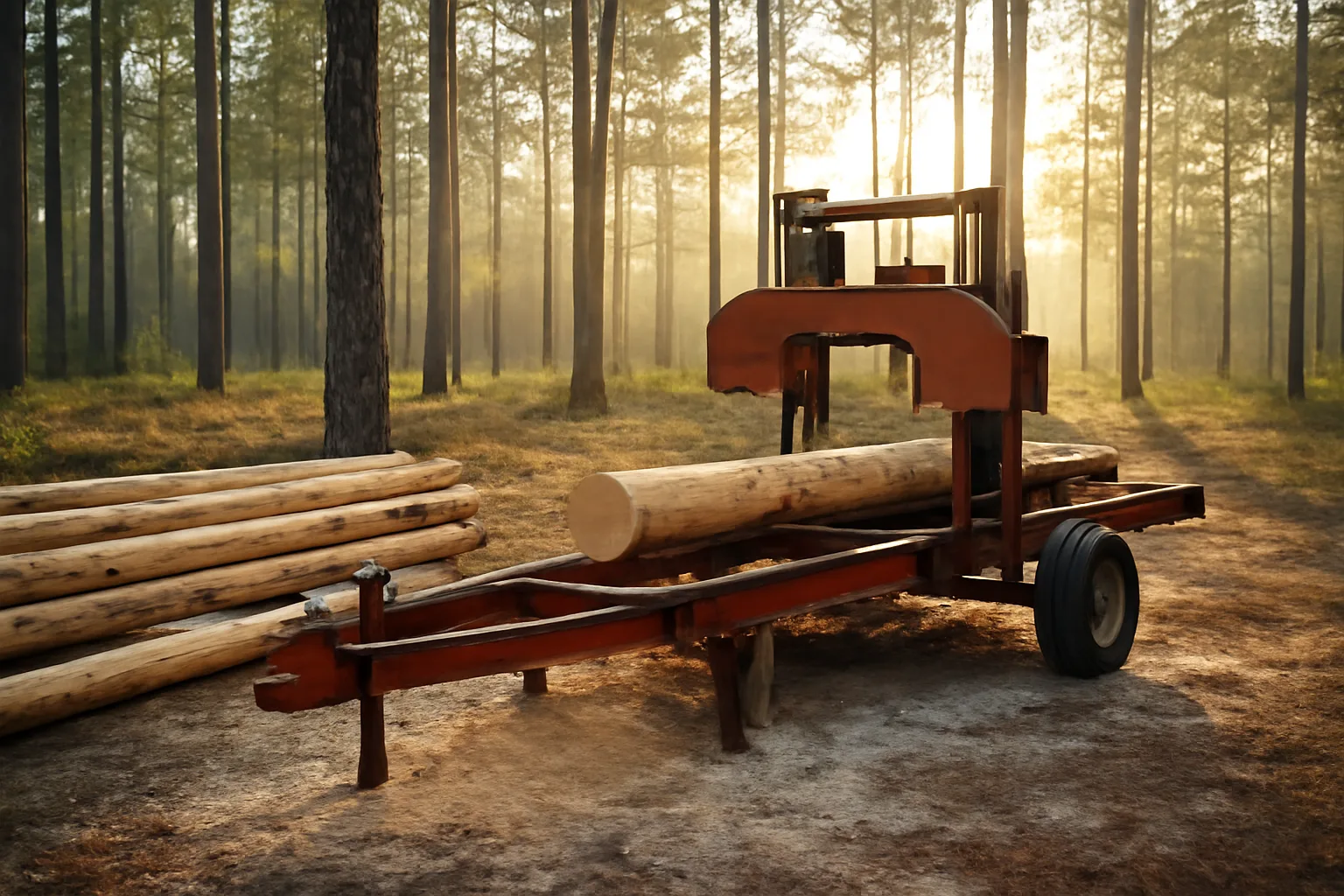
A portable sawmill Florida crews actually tow is usually a band mill on a trailer. The paper does not change because the mill has wheels. The land-use fight often gets harder, because you show up next to houses that never planned for a mill.
If you like comparing states, read portable sawmill license in Alabama after you finish this page. Do not mix the stacks.
What paper do you file first in Florida?
File the identity of the business first. Then tax accounts. Then local permission to operate at a site. That order keeps you from parking a mill on land you cannot use.
Most people form a Florida LLC with the Division of Corporations (Sunbiz) or operate as a sole proprietor under their legal name. If you trade under a name that is not your personal legal name or the exact legal entity name, section 865.09, Florida Statutes, is the fictitious name law. [2]
Confirm current dollar amounts on the Division of Corporations fee schedule before you pay a helper to handle Sunbiz. The fee list is public. [3] I would file a simple LLC myself. Paying a mill broker to click a form is usually a waste.
Ask the county tax collector, and the city if you sit inside one, about a local business tax receipt. Then, if you will sell lumber, register with the Florida Department of Revenue. Section 212.18, Florida Statutes, is the dealer registration statute. [4] Do not guess whether custom sawing is a service or a sale of goods. Ask DOR in writing.
Check zoning on the home-base parcel. A mill is loud and makes a pile. Neighbors file complaints about piles.
Then insurance. Then the employee question.
| Paper | Issuer | When it shows up |
|---|---|---|
| Entity filing (LLC or corp) | Florida Division of Corporations | You want an entity or a clean legal name |
| Fictitious name | Florida Division of Corporations | You advertise under a name that is not the legal name |
| Local business tax receipt | County or city | You engage in business there |
| Sales and use tax certificate | Florida Department of Revenue | You sell taxable tangible personal property |
| Workers' compensation | Authorized carrier | Your headcount and industry fit Chapter 440 |
Confirm each row with the issuer. This table is a map, not a permit.
How much does a portable sawmill cost in Florida?
There is no official Florida price for a portable sawmill. Dealers quote. Used mills sit all over the Southeast at whatever the last owner needs to get out.
Street prices I would budget around, knowing they move: a small manual band mill often lands about $4,000 to $12,000. A mid-size hydraulic mill commonly sits about $20,000 to $50,000. Large remote hydraulic machines run higher, sometimes past $70,000 before extras. Blades, a sharpener, cant hooks, a trailer that actually fits your truck, fuel, and a dry place to park add real money.
Do not buy the biggest mill first. Capacity you cannot feed is just a payment.
State-level paper is cheap next to the machine. The Division of Corporations publishes LLC and fictitious name amounts on its fee schedule. Confirm the live numbers there before you write a check. [3] County business tax receipts vary by county and classification. Some cities stack another receipt on top. Call the tax collector. Do not use a blog's old dollar figure.
| Item | Honest range | Confirm with |
|---|---|---|
| Small manual band mill | about $4,000 to $12,000 | dealers and the used market |
| Hydraulic mid-size mill | about $20,000 to $50,000 | dealers |
| State entity filings | published on the Sunbiz fee schedule | Division of Corporations |
| Local business tax | county-set | county tax collector |
| Sales tax on retail lumber | 6% state plus local surtax | Florida DOR |
Florida's general state sales tax rate is 6 percent, per the Florida Department of Revenue. [5] Counties add discretionary surtax. Confirm the combined rate for each job county.
Insurance, fuel, blades, and lost time on bad logs will beat your filing fees every year. If you want a worksheet for kerf loss and kiln shrink so you stop quoting wet board feet like a tourist, SawmillPath sells a one-time Board-Foot + Kerf + Kiln Kit for $149 at /start. You do not need it to follow this article.
For a side-by-side of how another state stacks money, portable sawmill cost in Colorado is a useful contrast, not a template.
How long does it take to get set up for a portable sawmill in Florida?
Two clocks. One is paper. One is the cut.
Florida has no statewide sawmill board queue, so nobody is sitting on a sawmill license for 90 days. Entity filings with Sunbiz often post on a short cycle when you file online, but I will not promise you a day count. Confirm current processing with the Division of Corporations. Local business tax receipts can be a same-week counter visit or a slower loop, depending on the county. Sales tax registration through DOR is a separate clock. Confirm it. No article gets to guarantee approval or timing.
The cutting clock is messier. Output depends on log diameter, species (dense live oak versus plantation pine), how many faces you open, target thickness, and how often you stop to swap a dull blade. Manufacturer marketing numbers run optimistic. Field reality on dirty, knotty Florida hardwoods is slower.
Nobody has a clean statewide time-and-motion study I trust. The closest honest statement is that small band mills often land in a few hundred board feet per hour on cooperative logs, and well under that on junk. Setup and teardown on a custom site can eat an hour or more each way. Drive time across a rural county can beat sawing time.
Quote the day, not the board, until you know the pile. If someone tells you they get fully licensed in 48 hours and saw 2,000 board feet before lunch, they are selling something.
Do you need a Florida sales tax account to sell lumber?
If you sell lumber, you likely need a Florida sales and use tax account. Lumber is tangible personal property. Florida taxes retail sales of tangible personal property unless an exemption applies. [4][5]
Custom sawing for a landowner who keeps their own logs can look like a service, a sale, or a mix. That distinction is a DOR fact question, not a forum vote. Get it in writing.
Section 212.18, Florida Statutes, is the registration statute for dealers. Read the current text before you decide you are too small to register. [4] Keep invoices that show who owned the log, what you charged, and whether tax was collected. Timber fights and tax audits both love missing paperwork.
Resale certificates exist when you sell to a dealer who will tax the next sale. Do not accept a napkin. Use DOR's certificate process.
If you only mill your own trees and never sell a board, you may not need a dealer account. The minute you sell slabs on a marketplace app, the facts change. Confirm with DOR.
Charge the combined rate that applies to the sale. The 6 percent state rate is only the floor. Local discretionary surtax is real money on a truckload of boards.
What about workers' compensation and hired help?
Florida workers' compensation lives in Chapter 440. It is not optional folklore.
For most private, non-construction work, employment under the statute includes private employments in which four or more employees are employed by the same employer. That definition sits in section 440.02, Florida Statutes. [6] Construction is a tighter net (one employee can be enough). A portable mill used only to custom-cut logs is usually discussed as manufacturing or a service, not as building a house. If you also frame houses, you just changed categories. Confirm with a Florida workers' compensation lawyer or the Division of Workers' Compensation. I am not your lawyer.
Section 440.10 requires covered employers to secure compensation. [7] Family labor, casual labor, and corporate officer exemptions are easy to get wrong. Do not take a Facebook group's word for an exemption.
If you stay solo, you may still want a voluntary policy, because hospital bills from a bandsaw do not care about headcount. That is a personal risk call.
Reemployment (unemployment) tax is a separate Florida Department of Revenue account if you have employees. [8] Payroll paper is its own stack. Budget time for it before you hire the third person and hope nobody is counting.
Does OSHA apply to a portable mill in Florida?
If you have employees, OSHA's general industry rules apply. Sawmills have their own section.
29 CFR 1910.265 is the federal sawmill standard. It opens with this scope line: "This section includes safety requirements for sawmill operations including, but not limited to, log and lumber handling, sawing, trimming, and planing; waste disposal; operation of dry kilns; finishing; shipping; storage; yard and yard equipment; and for power tools and affiliated operations." [9]
A trailer mill in a pasture is still a sawmill operation if you are doing that work. Guards, lockout, PPE, and log handling are not optional theater.
OSHA does not issue your Florida business license. It will still write citations after an accident. Read 1910.265 before the first hired hand touches a cant.
Solo operators still get to keep their fingers. The standard is a decent checklist even when enforcement looks different. A kickback does not ask whether you filed Sunbiz.
Can you sell ungraded lumber in Florida?
You can sell a lot of things. You cannot pretend ungraded boards are code-approved structural lumber.
The Florida Building Code (the Florida adoption of the model code, with state amendments) requires sawn lumber used for load-supporting purposes to be identified by the grade mark of an accredited lumber grading or inspection agency, with the exceptions stated in the code text. Read Chapter 23, Wood, in the current Florida Building Code before you advertise cabin-grade 2x6s for floor joists. [10]
Hobbyists buying slabs for a live-edge table are a different customer than a contractor pulling a permit. Say that out loud in your quotes.
SPIB and other ALSC-accredited agencies grade southern pine. Getting your own grade stamp is a serious quality program, not a weekend sticker. Most portable mills should never claim a grade they do not have.
If a buyer wants structural lumber, send them to a dealer or get the pile properly graded. Selling fantasy joists is how you fund someone else's lawyer.
California's structural and business stack is a different animal. Skim portable sawmill license in California only as a contrast.
What forestry and land rules hit a portable mill?
If you harvest timber, Florida expects silviculture best management practices around streams, wetlands, and roads. The Florida Forest Service (FDACS) publishes the Silviculture BMP program and trains landowners on it. [11]
Implementing adopted BMPs can support a presumption of compliance with state water quality standards under Florida's water-quality implementation statute. Section 403.067, Florida Statutes, is the framework statute for that BMP system. [12] Read the current subsection that applies to agricultural and silvicultural BMPs. Do not treat a presumption as a free pass to dump fuel in a creek.
A portable mill on a pad next to a cypress strand is a wetland problem waiting for a water management district. If you fill, dredge, or build in wetlands, you are in Environmental Resource Permit territory (FDEP or the water management district). Walk the site with a wetland person before you grade a landing.
County clearing ordinances and noise rules are local. If you burn slabs, Florida's open burning statute, section 590.125, Florida Statutes, is the starting text, and Florida Forest Service authorization is the practical step. [14] Do more than light it.
Buying logs: get a written bill of sale and know who owns the timber. Timber theft is a real Florida problem, and "a guy in a pickup said it was fine" is not a title.
Agricultural classification (greenbelt) under section 193.461, Florida Statutes, is a property-tax question, not a milling permit. [15] A commercial yard can blow a greenbelt fact pattern. Ask the property appraiser about your parcel.
For how another Gulf-adjacent state handles the start sequence, how to start a portable sawmill in Alabama is a fair read after this one.
What do county zoning and business tax receipts look like?
Zoning decides whether a mill is a home occupation, agriculture, manufacturing, or a code-enforcement case. Florida's 67 counties write this differently. A five-acre ag parcel in a rural county is not Miami-Dade.
Ask planning staff two questions. Is a portable sawmill allowed on this parcel? Do I need a special exception, site plan, or home-occupation registration?
Noise, hours, truck traffic, and off-site sales are where neighbors file complaints. A mill that only cuts the landowner's logs a few days a year is a different land-use fact than a commercial yard with a kiln and a storefront.
The local business tax receipt is the receipt you hang on the wall. Chapter 205 authorizes it. Rates and classifications are local ordinances. [1] Confirm the classification (manufacturing, contractor, miscellaneous services) with the tax collector. Pick the class they tell you, not the cheapest name you like.
Cities inside counties can add their own receipt. If you mill in five cities, ask whether you need five receipts or whether the work is mobile enough that the home-base receipt is what they want. Get the answer in writing. This is where people get nickel-and-dimed.
Arkansas treats the start path differently on the forestry side. portable sawmill license in Arkansas is only useful as a contrast.
What trailer, highway, and CDL rules apply when you move the mill?
Your mill is also a trailer. Weight and width rules apply the minute you pull onto a state road.
Federal CDL rules apply in Florida. A commercial motor vehicle under 49 CFR 383.5 includes a combination with a gross combination weight rating of 26,001 or more pounds if the towed unit is more than 10,000 pounds, among other triggers. Confirm against that definition and Florida DHSMV, not a mill dealer. [13]
Overwidth decks need oversize thinking. A mill that is legal in the driveway can be wide on a two-lane state road. Measure it.
Secure the mill. A bandsaw frame that shifts is a highway incident, not a cute story.
Farm tags and agricultural exemptions are easy to abuse. If you run a commercial custom mill, you are probably not a farm implement on a joyride. Ask a tag agent with the actual GVWR.
Put commercial auto and inland marine coverage on the mill before the first paid move. Confirm with an agent who understands contractors and equipment, not only personal pickup policies.
If you later add a second rural state, read that start guide as its own stack. how to start a portable sawmill in Arkansas will not match Florida's county-tax model.
What would I actually do in year one?
Keep a day job until the mill is booked without begging. Florida custom work is seasonal around weather, hunting leases, and hurricane cleanup. Hurricane-downed timber looks like free money. It is also dirty, steel-filled, and legally messy if ownership is unclear.
Year one paper, in order: entity or sole prop decision, Sunbiz filings if needed, county and city business tax, DOR sales tax if I will sell, insurance binder, then a written zoning check on my home base. Then one mill I can tow with the truck I already have.
I would not build a kiln in month one. I would not buy a debarker. I would not take structural-lumber jobs.
I would write every quote with log ownership, who cleans the landing, how slabs are left, and that boards are ungraded unless I say otherwise.
Track kerf and moisture or you will underprice every job. That is operator homework, not a state form.
If you later add a western state, read that state's guide as its own stack. portable sawmill license in Colorado and how to start a portable sawmill in Arizona will not match Florida's county-tax model.
What Florida mistakes waste money?
Waiting for a state portable sawmill license that does not exist. Overbuying hydraulics. Quoting dimensional lumber as if it were graded southern pine. Skipping the county tax collector. Accepting logs with no bill of sale. Burning piles without authorization. Hiring help and ignoring Chapter 440. Parking the mill in a wetland. Promising kiln-dried 12 percent moisture with a tarp and a prayer.
Another waste: paying a consultant to get you fully licensed in all 67 counties when you work three rural counties and a marketplace-app radius.
Read primary pages. Call the clerk. Keep emails.
SawmillPath is an independent publisher. It is not a law firm and not a permit service. If you want the Board-Foot + Kerf + Kiln Kit, it is a $149 one-time download at /start. This article stands without it.
Frequently asked questions
Do you need a license for portable sawmill in Florida?
Florida issues no statewide portable sawmill operator license. You still need ordinary business paper. That usually means a county (and maybe city) business tax receipt, Sunbiz filings if you form an entity or use a fictitious name, and a Department of Revenue account if you sell lumber. Confirm each item with the issuer. Zoning can block a site even when tax receipts are in order.
How much does portable sawmill cost in Florida?
The machine is the big number. Small manual band mills often sit about $4,000 to $12,000. Hydraulic mills commonly run about $20,000 to $50,000, and large rigs go higher. State filing amounts are on the Sunbiz fee schedule and are small next to the mill. County receipts vary. Confirm live fees with each board. Insurance, blades, and fuel will outspend filings.
How long does portable sawmill take in Florida?
There is no state sawmill board waiting list. Sunbiz, county tax, and DOR each run their own clock. Confirm current processing with those offices. Do not take a promised number from a sales pitch. On the job, a small mill may cut a few hundred board feet an hour on clean logs, and much less on dirty Florida hardwoods. Site setup can eat the morning.
Is a Florida LLC required to run a portable mill?
No. You can operate as a sole proprietor under your legal name. An LLC is a liability and banking choice, not a sawmill permit. If you use a trade name, fictitious name registration under section 865.09 can apply. Confirm filings and current fees with the Division of Corporations before you pay a third party to click the form.
Do I need a timber dealer license in Florida?
Florida Forest Service and FDACS do not issue a general portable sawmill operator license. Florida also does not publish a Georgia-style statewide timber-dealer card for this work. You still need clean title to the logs, plus sales tax and local business tax if you are in business. If your fact pattern is buying standing timber for resale, ask FDACS and a timber lawyer what extra paper applies.
Can I run a portable sawmill on agricultural land in Florida?
Maybe. Zoning decides use. Agricultural classification (greenbelt) under section 193.461 decides tax assessment. Those are different offices. A mill that becomes a commercial yard can blow both. Ask planning staff and the property appraiser about your parcel before you pour a pad or stack a log deck.
Does Florida charge sales tax on custom sawing?
It depends on whether DOR sees a sale of tangible personal property, a service, or both. Retail lumber sales sit in the sales tax system. The state rate is 6 percent plus local surtax. Ask DOR about your exact invoice structure and keep the written answer. Internet guesses are how you pay the tax twice.
Do I need graded lumber stamps for slabs?
Not for a coffee table slab sold as a slab. Yes, in practice, if someone will use the boards as load-supporting lumber under a building permit. The Florida Building Code wants grade-marked sawn lumber for those uses. Do not stamp what you did not grade. Write ungraded into the quote so the buyer cannot claim otherwise later.
What insurance should a portable mill in Florida carry?
Talk to an independent agent about general liability, inland marine on the mill, and commercial auto on the tow vehicle. If you have employees, workers' compensation is a Chapter 440 question, not a vibe. I will not invent a premium. Quotes vary with claims history, equipment value, and county.
Can a non-resident operate a portable mill in Florida?
You can bring a mill across a state line. You still owe Florida paper if you are doing business here, including local business tax, sales tax if you sell, and foreign LLC qualification if your entity is from elsewhere. Confirm foreign qualification with the Division of Corporations. CDL and weight rules still apply on Florida roads.
Do I need a burn authorization for sawmill scrap in Florida?
If you burn, follow section 590.125 and Florida Forest Service authorization rules, plus any county burn ban. An agricultural label is not a free pass to ignite a slab pile beside houses. Call Florida Forest Service for the current authorization method. When in doubt, haul the scrap.
Are portable sawmills exempt from OSHA in Florida?
No special portable mill exemption wipes OSHA away. If you have employees, general industry rules and 29 CFR 1910.265 are the starting text. Solo work is a different enforcement picture. Fingers do not care. Read the standard before anyone new steps up to the bunk.
What if I only mill my own trees in Florida?
You still need land-use permission and safe equipment. You may avoid sales tax dealer status if you never sell a board. The minute you sell, the tax facts change. BMPs still matter if you harvest near water. Confirm tax treatment with DOR rather than assuming your own trees means no rules.
Who do I call to confirm Florida fees and forms?
Division of Corporations for entity and fictitious name amounts. The county tax collector for the local business tax. Florida Department of Revenue for sales tax and reemployment tax. Florida Forest Service for BMPs and burning. The planning department for the parcel. SawmillPath is not those offices and does not collect fees.
Sources
- Florida Senate, s. 205.032, Florida Statutes (Levy; counties): A Florida county may levy a business tax for the privilege of engaging in or managing any business, profession, or occupation within its jurisdiction.
- Florida Senate, s. 865.09, Florida Statutes (Fictitious name registration): Florida requires fictitious name registration with the Division of Corporations when a person engages in business under a name other than the legal name.
- Florida Division of Corporations (Sunbiz), Limited Liability Company fees: The Florida Division of Corporations publishes current LLC and fictitious name filing amounts on its Sunbiz fee pages.
- Florida Senate, s. 212.18, Florida Statutes (Administration of law; registration of dealers): Florida sales and use tax dealers must register under section 212.18.
- Florida Department of Revenue, Florida Sales and Use Tax: Florida's general state sales tax rate is 6 percent, with additional local discretionary surtax in many counties.
- Florida Senate, s. 440.02, Florida Statutes (Definitions): For most private non-construction employment, Florida workers' compensation coverage turns on employing four or more employees, with a tighter construction trigger.
- Florida Senate, s. 440.10, Florida Statutes (Liability for compensation): Covered Florida employers must secure workers' compensation for their employees.
- Florida Department of Revenue, Reemployment Tax: Florida reemployment tax is administered by the Department of Revenue for employers with covered employees.
- U.S. OSHA, 29 CFR 1910.265 Sawmills: Federal OSHA standard 1910.265 sets safety requirements for sawmill operations including log and lumber handling, sawing, and dry kilns.
- ICC, 2023 Florida Building Code, Building, 8th Edition, Chapter 23 Wood: The Florida Building Code's wood chapter requires grade identification for sawn lumber used for load-supporting purposes, subject to the code text.
- Florida Department of Agriculture and Consumer Services, Silviculture Best Management Practices: The Florida Forest Service publishes silviculture BMPs as the state's minimum forestry practices for protecting water quality.
- Florida Senate, s. 403.067, Florida Statutes (Establishment and implementation of total maximum daily loads): Section 403.067 is the Florida framework statute under which adopted agricultural and silvicultural BMPs can support a presumption of water-quality compliance.
- eCFR, 49 CFR 383.5 (Commercial driver's license definitions): A combination with a GCWR of 26,001 or more pounds can be a commercial motor vehicle when the towed unit exceeds 10,000 pounds, among other CDL triggers.
- Florida Senate, s. 590.125, Florida Statutes (Open burning authorized by the Florida Forest Service): Florida open burning of yard and land-clearing debris is regulated under section 590.125 and Florida Forest Service authorization rules.
- Florida Senate, s. 193.461, Florida Statutes (Agricultural lands; classification and assessment): Florida agricultural classification (greenbelt) for property tax is a separate determination from zoning or a business tax receipt.